
Tesamorelin, CJC-1295 and Ipamorelin: Signals, Not Synthetic HGH
All three act on the body's own growth-hormone system rather than replacing it. Where they act — and how much human evidence stands behind each — is what separates them.
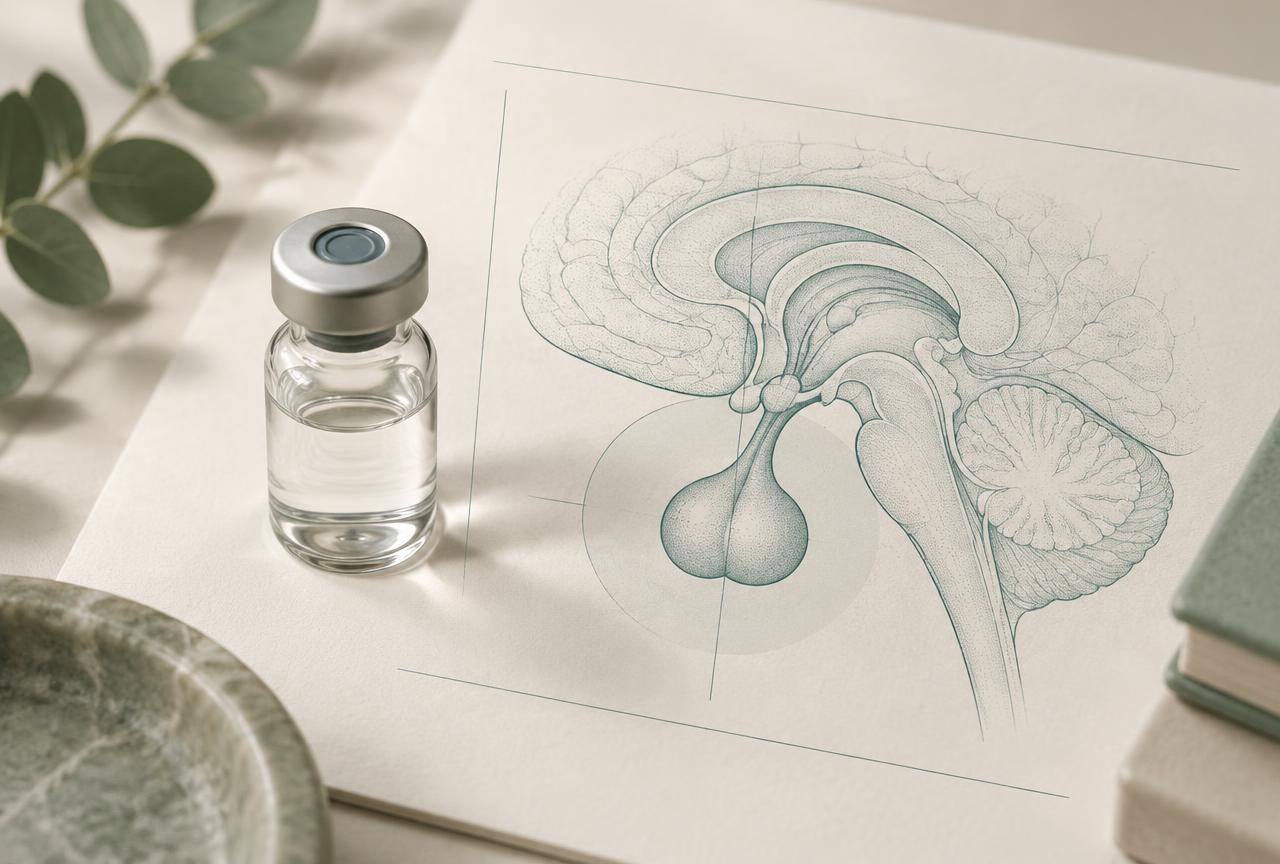
Tesamorelin and the CJC-1295/ipamorelin pairing are frequently discussed as if they were interchangeable with injected human growth hormone. They are not. Each works by prompting the pituitary to release the body's own growth hormone, and the differences between them sit in which receptor they touch and how much human data exists behind that mechanism.
Understanding the underlying pathway makes the distinctions obvious — and makes it much harder to be misled by marketing language.
The natural growth-hormone pathway
In normal physiology the hypothalamus releases growth-hormone-releasing hormone (GHRH). GHRH reaches the anterior pituitary, which releases growth hormone (GH) in pulses rather than as a steady stream. GH then acts on tissues throughout the body and signals the liver and other tissues to produce insulin-like growth factor 1 (IGF-1).
Two brakes regulate the system: somatostatin, which suppresses GH release, and IGF-1 itself, which feeds back to restrain further output. The pulsatility and the feedback are features, not quirks — the tissue response to GH depends partly on the pulse pattern, not only the total amount.
Downstream, GH and IGF-1 signalling contributes to fat metabolism, protein synthesis, muscle and connective-tissue maintenance, bone turnover, recovery from tissue stress, and broader metabolic regulation.
Tesamorelin: a GHRH analogue with a label
Tesamorelin is a stabilised analogue of GHRH. It binds the GHRH receptor on the pituitary and mimics the natural upstream signal: tesamorelin acts on the GHRH receptor, the pituitary releases endogenous GH, and IGF-1 rises as a consequence.
That distinction matters. Tesamorelin does not supply GH; the FDA prescribing information describes it as stimulating the synthesis and pulsatile release of endogenous growth hormone. The pituitary remains the source, and the body's own feedback loops remain in the circuit.
Tesamorelin also carries substantially more clinical data than most compounds in this category. It is FDA-approved as Egrifta for the reduction of excess visceral abdominal fat in adults with HIV-associated lipodystrophy. It is not approved as an anti-ageing therapy or a general weight-loss drug, and the approved indication is narrower than the way the compound is often discussed.
CJC-1295: the same receptor, far thinner evidence
CJC-1295 acts on the same receptor family as tesamorelin: it binds the GHRH receptor, the pituitary produces and releases GH, and IGF-1 follows. Published human work reported significant increases in both GH and IGF-1 after administration.
One finding from that literature is worth holding onto: GH secretion remained pulsatile even with sustained exposure to long-acting CJC-1295. Stimulating the pituitary is not equivalent to injecting GH, and the resulting pattern of release differs.
A terminology problem sits underneath most CJC-1295 discussion. Authentic CJC-1295 includes a drug affinity complex (DAC) that makes it long-acting, and that is the molecule studied clinically. Material sold as "CJC-1295 without DAC" is generally a short-acting GHRH analogue better described as modified GRF(1-29). It should not be treated as the same compound, and the clinical data on CJC-1295 with DAC does not transfer to it.
Ipamorelin: a different receptor entirely
Ipamorelin reaches GH release through another door. Instead of the GHRH receptor, it stimulates the growth-hormone secretagogue receptor — the ghrelin receptor, GHSR-1a — producing pituitary and hypothalamic signalling that results in a GH pulse.
Early research characterised ipamorelin as relatively selective for GH release compared with some older growth-hormone secretagogues, with substantially less stimulation of ACTH and cortisol in experimental models. That selectivity is the reason it attracted attention, but the work supporting it is largely preclinical and early-phase rather than outcome-driven human research.
Why CJC-1295 and ipamorelin are paired
The pairing is a mechanistic argument rather than a trial result. CJC-1295 works through the GHRH pathway; ipamorelin works through the ghrelin/GHS pathway; combining them targets two complementary inputs to the same pituitary output, with the intent of producing a stronger physiological pulse than either input alone.
There is genuine biological precedent for the idea: GHRH and ghrelin/GHS signalling interact strongly in the control of GH secretion, and co-stimulation studies show larger responses than single-pathway stimulation. What does not exist is a body of human trials studying the specific blended product as a blend, at the ratios sold, for the outcomes people care about.
Held side by side: tesamorelin is a strong GHRH signal with an approved label; CJC-1295 is a GHRH signal with limited human data; ipamorelin is a complementary ghrelin/GHS signal with mostly preclinical data. None of the three is growth hormone.
What raising GH and IGF-1 actually does
When GH and IGF-1 rise within a physiological range, the pathway can influence visceral-fat metabolism, lean-tissue maintenance, protein synthesis, bone and connective-tissue turnover, and recovery. That is the reason the category is studied at all.
Higher is not automatically better. Excessive or prolonged GH and IGF-1 signalling is associated with fluid retention, numbness and carpal-tunnel-type symptoms, joint discomfort, insulin resistance or elevated glucose, and IGF-1 levels above the normal range. Tesamorelin's prescribing information specifically directs monitoring of IGF-1 and glucose-related effects — a reminder that even the approved member of this class is managed with laboratory follow-up rather than assumed to be benign.
The long-term consequences of sustained elevation are also the part of the picture with the least data, particularly for compounds used outside approved indications.
The distinction that matters most
The mechanistic differences are interesting, but the practical divide is evidentiary. Tesamorelin is an approved medication with substantial human clinical data, a defined indication, documented adverse events and a monitoring plan. CJC-1295 and ipamorelin are not approved therapies and have considerably thinner human safety and outcome evidence.
In plain terms: all three are best understood as signals telling the body's own growth-hormone system to work harder, not as replacements for that system. What differs is how confidently anyone can say what happens next.
Research references
- Prescribing label
EGRIFTA (tesamorelin for injection) — FDA prescribing information
- Main finding
- Describes tesamorelin as a GHRH analogue that stimulates synthesis and pulsatile release of endogenous growth hormone; indicated for reduction of excess visceral abdominal fat in adults with HIV-associated lipodystrophy.
- Limitations
- Not approved for anti-ageing or general weight loss. Label directs monitoring of IGF-1 and glucose.
- Clinical trial
Effects of CJC-1295, a long-acting GHRH analog, on GH and IGF-1 in healthy adults
- Population
- Healthy adult volunteers
- Main finding
- Significant, sustained increases in GH and IGF-1; GH secretion remained pulsatile despite continuous exposure to the long-acting analogue.
- Limitations
- Small, short-duration pharmacology studies; no clinical outcome endpoints.
- Animal study
Ipamorelin, the first selective growth hormone secretagogue
- Main finding
- Ipamorelin released GH with substantially less ACTH and cortisol stimulation than comparator secretagogues in experimental models.
- Limitations
- Preclinical characterisation; selectivity findings have not been confirmed in large human trials.
- Narrative review
Interaction of GHRH and ghrelin/GHS receptor signalling in the control of GH secretion
- Main finding
- GHRH and ghrelin/GHS pathways act through distinct receptors and interact synergistically in regulating pituitary GH release.
- Limitations
- Mechanistic literature; does not evaluate any specific combination product or ratio.
This article is educational and is not medical advice. It does not recommend or provide individualised dosing. Speak with a qualified healthcare professional about your own health.